
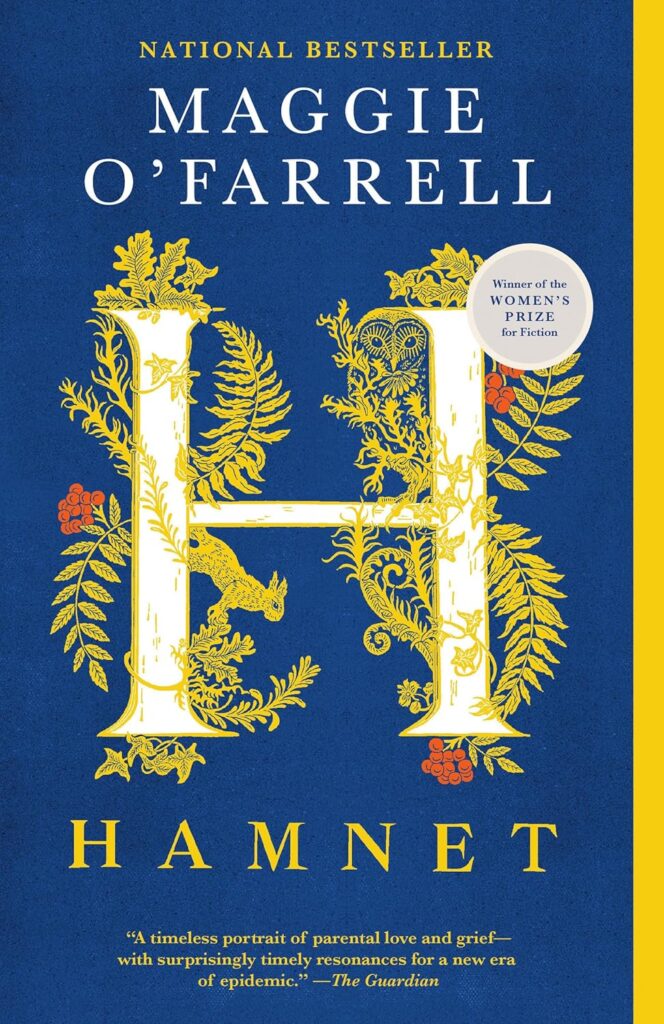
Started reading the real (physical) book and switched to the audiobook on Libby. Interestingly, it’s published as Hamnet & Judith in Canada, but Hamnet in the US/UK.
I’m grateful I listened to the audiobook. The narrator of the version I listened to was Daisy Donovan, and her voice was lovely and lilting. I felt immersed in England, immersed in the late 1500s and early 1600s, and its very unwavering depiction of not-so-glamorous Elizabethan life.
Many thoughts about this novel, a fictionalized account of Shakespeare’s marriage and family, the circumstances leading to his marriage at 18 to the 26-year-old Agnes, their horrible respective families, the death of his 11-year-old son Hamnet due to plague, Shakespeare’s success in London (seen only from afar, as his family did not leave Stratford), and ultimately Shakespeare’s a.
O’Farrell is an absolutely beautiful, sumptuous writer. I read her memoir, I Am I Am I Am, last year. Also beautifully written, her memoir focuses on the 20 odd times she or a loved one has nearly escaped death. Nice gal, I’m sure, but I’m not hanging around with her. Bad. Luck.
Hamnet was made into a movie last year and was up for a bunch of Oscars earlier this month. Haven’t seen the movie, and I’m completely boggled as to how this novel gets turned into a movie. The book is almost entirely in Agnes’ head – her appreciation of nature, her love of her Kestrel hawk, her navigation of her husband’s family’s dynamics. There’s the barest bit of a plot (and spoiler alert, as with Titanic, we know how it’s going to end). Not that much really happens:
Early glimpses of dysfunctional families for Agnes and her husband (who is never named – was the idea supposed to be that the reader is surprised, at the end, when it turns out Agnes’s husband and Hamnet’s father is William Shakespeare? Were we not supposed to have guessed or known?). The husband’s father is a drunken violent brute. Agnes’ stepmother has no love for Agnes and resents her and her brother, resents that they will inherit the farm.
Agnes has other-worldly abilities – like her mother, she is possibly a forest sprite, and has innate healing and clairvoyant capacity. She can look at someone and know if they are sick, diseased, long for this earth.
Agnes and “her husband” falling in love, getting pregnant, seeking his parents’ consent to marry at his young age. The births of their children, including twins Hamnet and Judith.
The husband drops into a deep depression early in the marriage. He adores Agnes, he adores his daughter Susanna. But his father is a drunken brute, and the husband resents every day spent in Stratford, near his father, eking out a pretty unrewarding life of tutoring local children in Latin and running errands for his father’s glove-making business. Agnes schemes with her beloved brother for a pretense for her husband to move to London, where he will seek further opportunities for his father’s business. Agnes and the children will follow – but they never do. Judith is born weak and sickly, and she would never survive London.
The plague is omnipresent – mostly in London, where it shuts down the theatre and sends the husband home to Agnes and the family in Stratford every now and then. Then the plague arrives in Stratford and attacks both Judith and, Agnes learns too late, Hamnet. O’Farrell writes a distracting tangent (in my opinion) following the journey of the flea that bites Judith (and presumably also Hamnet), by ship, from Italy to Stratford, and leaves a wake of casualties in its path. This tangent was my least favourite part of the book. It inserts itself in the space while we know Judith is very very sick and suspect Hamnet also, and we want to get to their inevitable fates. The flea, quite frankly, annoyed me.
Agnes and her husband bury and, separately and at a distance, grieve Hamnet. The novel culminates in Agnes’ first trip into London to see the play that her husband carelessly (or ot) named after their dead son (Hamnet and Hamlet apparently being interchangeable names in that time). Agnes is furious and betrayed. Until she slowly understands that the play is her husband’s attempt to revive and memorialize their son.
Hamnet is a gentle, detailed, grief-stricken glimpse into the life of Shakespeare’s family, and how the tragedy of losing his only son may have influenced one of his most famous pieces of art.