Possibly the most perfect closing paragraphs of any novel, ever. Graeme & I bonded over 30 years ago over a shared love of this book and these words. (And Billy Bragg.)
And as I sat there brooding on the old, unknown world, I though of Gatsby’s wonder when he first picked out the green light at the end of Daisy’s dock. He had come a long way to this blue lawn and his dream must have seemed so close that he could hardly fail to grasp it. He did not know that it was already behind him, somewhere back in that vast obscurity beyond the city, where the dark fields of the republic rolled on under the night.
Gatsby believed in the green light, the orgastic future that year by year recedes before us. It eluded us then, but that’s no matter – tomorrow we will run faster, stretch out our arms further … And one fine morning –
So we beat on, boats against the current, borne back ceaselessly into the past.
Lou Berney’s November Road came highly recommended to me, by someone whose taste is impeccable. “Stylized historical crime fiction” – not my usual fare at all. It’s the kind of book that has a blurb from Stephen King on the cover. (Which I’m fine with. Hey, I’ve read my fair share of Stephen King in my lifetime, admittedly mostly in high school. But I still love The Stand to this day.)
My expectations were high, and I wasn’t disappointed. November Road is a very good read. Extremely well-written, a compelling page-turner.
Here’s the premise: Set against the backdrop of JFK’s assassination, we meet Frank Guidry, a handsome, charming and entirely amoral New Orleans mafioso. Oops, turns out he played a small part in the assassination, unwittingly. He’s a rook in a game of payback orchestrated by his mob boss Carlos, who really didn’t appreciate Jack and Bobby hauling him to testify before Congress about organized crime. Turns out mob bosses hold grudges.
So Frank, always one step ahead, scrams when he sees other unwitting pawns getting offed all over New Orleans. Carlos is cleaning up loose ends. Frank’s on the lam, and along the way he meets up with Charlotte and her two young daughters, who are all headed to California.
Charlotte’s back story is pedestrian – she’s decided her life with a hopeless drunk of a husband in small town Oklahoma is going nowhere. JFK’s assassination barely makes an imprint on her – what does she care, her life will never change, she could write all of her next chapters on a napkin. After a depressing pre-Thanksgiving family dinner filled with pretense, Charlotte’s mother-in-law presses a wad of cash into her palm in unspoken gratitude for suffering her useless alcoholic son. Charlotte sees an opening and takes it. She packs her bags and the kids’ bags and they are off, with the car, the epileptic dog, and $300. So long drunk Dooley. Bye bye Oklahoma.
After their chance meeting, Frank decides to use Charlotte’s car trouble and the insta-family she provides to create a cover story for his own trek to Vegas. The bad guys looking for him won’t be looking for a family man on a Thanksgiving road trip with the pretty wife and sweet girls.
But the twist in November Road is that Frank falls for his own cover story. He falls in love with Charlotte … and her kids. He desperately wants the sham to become a reality. He wants to be a husband and, yes, even a father. His own father was a brutal asshole who ended up murdering Frank’s younger sister (with a fire poker, yikes) after Frank escaped his abusive home at an early age. However crappy a guy he is, Frank thinks about his sister every day.
Now here’s pretty, smart and thoughtful Charlotte – they can be a family together and right this ship for both of them. She admits she’s left hubby, and Frank assumes she must need a replacement. Here’s the family he never had, pre-packaged, and right at his door step.
Of course (spoiler alert) this Brady Bunch fantasy can never happen – Frank’s only hope for surviving Carlos’ wrath is getting the hell outside North America, as far away from Carlos as humanly possible. Vietnam is the plan, and it’s going to be tricky to get Charlotte to agree to that side trip. By the way, Charlotte’s interest in acquiring another hubby, even one as charming and handsome as Frank, is less than nil. Sex, sure, but otherwise she’s making her own way from now on. Men just drag you down.
November Road is at its heart a novel of redemption. We initially meet the Frank Guidry who rats out his oldest friend, who’s on Carlos’ shit list, after he’s sought Frank’s protection. He becomes the Frank Guidry who is prepared to sacrifice his own life for another’s. We initially meet the Frank who objectifies, exploits, and disposes of a long line of willing New Orleans women. In stark contrast to the Frank who grows to idolize and idealize Charlotte.
Yet Charlotte isn’t Frank’s salvation. Rather, it’s his newfound insight into what a healthy and nurturing parent-child relationship can be. He’s a man willing to sacrifice himself, and more for the kids than for Charlotte. Those girls deserve the chance at life that his asshole father stole from his sister.
Frank Guidry at the end of November Road is a changed man, a man trying to be decent for the first time in his life. A man willing to protect rather than run.
The best part of November Road, the most apt and fitting, is its epilogue, set decades later. Charlotte’s two daughters, both impressive movers and shakers shaped by their mother’s grit and determination, visit her grave. They have a fleeting memory of that road trip when they were little kids, with … who was that man? They don’t know that road trip shaped their lives. And their saviour Frank is largely unremembered and entirely redeemed.
In law school I walked by a car wash every day for 3 years. Setting: We lived in downtown Toronto, very very multicultural. In the third year I asked Graeme: What’s so special about “Polish wax”? My then fiance’s response: Are you retarded?
After I had read all Harry Potter books, and watched all Harry Potter movies, Graeme had to point out to me that Diagon Alley was a play on the word “diagonally”.
At lunch with Paula, I’m trying to figure out what the sign across the road says: Mo On Li Te. Is that restaurant called Mow on Lee Tay? Pause. Moonlight, says Paula, laughing.
Note: This blog was written three summers ago, when we were staying at a rented house in Mahone Bay for a couple weeks. I guess I never got around to publishing it …
Here are some thoughts about reading real books. I should do more of it.
I just
finished reading a couple real books.
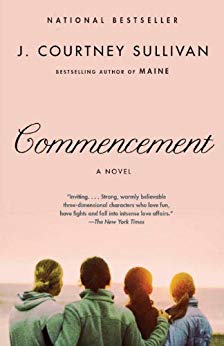
Commencement, by J. Courtney Sullivan.
Not Ulysses, or Bleak House, or The Life and Death of Ivan Denisovich. Only one of which I’ve read. But an actual fictional novel.
Commencement is the story of four young women who meet and live together in residence their first year at Smith, an all-girl college in Massachusetts. The book follows them through college, romances, career aspirations, and into the real world. It ends when they are all just over the hump of age 25.
I truly enjoyed this book, and how realistically it portrayed female friendships. These girls were not cookie cutters or clichés; they were all real, they were all different. They had the common bond of Smith among them, but otherwise came from diverse geographies, socioeconomic backgrounds and families. It portrayed them all as ambitious, in their own ways. Sally marries early (before 25, the right guy? the right reasons?) and gets pregnant unexpectedly. Bree falls into a lesbian relationship in college (apparently almost de rigeur at Smith), comes out to unaccepting parents, and struggles to balance family vs. relationship. She’s a successful young lawyer in San Francisco, so I got that. Another, Celia, the aspiring writer, is stuck in a grim entry-level publishing job in NYC that saps her creativity; she dates but comes to realize she has little interest in a “relationship” or motherhood. And then there is April, the rebel, the radical feminist, the would-be anarchist seeking an ill-fated maternal figure; the latter half of the novel revolves around her unexpected disappearance in Atlanta, and brings the friends together again after an alienating alcohol-laced fight before Sally’s wedding.
I liked
each of the characters. Like I say, they were real, and different, and yet
their friendships worked. And the jockeying, power-plays and acceptance of the
different dynamics amongst the friends, in their various combinations and
permutations, was well done – speaking from experience.
The book had a great, surprise ending, and I’ve rarely wished for a sequel to a book as much as I’m wishing to find out what happens next, after the final page of Commencement.
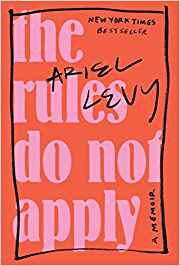
This week I finished a memoir I’d been eager to read. Called The Rules Do Not Apply, by Ariel Levy. I was told to expect to cry. I didn’t. I didn’t relate to Ariel very much (I related much more to Sally, Bree and Celia – not so much to April.) Ariel is a writer. Extremely talented writer – lots of underlining of lovely passages. And look at the pretty words I had to look up as I read:
Lickerish
(greedy)
Labile (changing)
Lambent
(softly radiant)
Coruscate (emit
flashes of light)
She’s
bi-sexual, gets married to an older butch lesbian (don’t call her Ariel’s wife
– Ariel is the wife!). She struggles with wanderlust and the desire to be a
mother. She becomes pregnant, travels to Mongolia on assignment, and gives
birth so prematurely (19 weeks) that doctors say it was a miscarriage and yet
the baby was born alive, breathing. Ariel feels she’s lost a baby, beyond a
miscarriage. She took a picture of the
baby; he existed. She insists on showing the picture more than she ought. She develops an odd correspondence with the
older South African doctor who tended to her in Mongolia.
A life far more outrageous and memoir-worthy than mine. So I didn’t relate, but I did love the prose; and her story gripped me, and I was sorry when it ended. And I hoped she didn’t fall into an ill-advised relationship with Dr. South Africa – it would have been a rebound thing, not good for either of them.
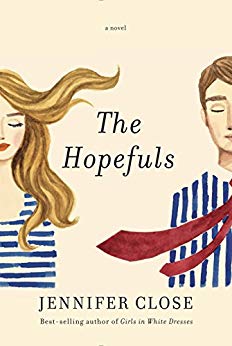
I’m in the middle of reading Jennifer Close’s The Hopefuls. I’ve read her past two books – one a series of short stories, and one a novel. I love her narrative voice. It’s a Millenial, weary, detached-while-trying-to-participate voice. Always the outsider looking in, and in doing so, being spot-on with observations and hilarious in her outsider comments. It’s taking me a while to get through it.
None of the
“real” books I’ve been reading have been escapist. Commencement is maybe chick lit, I’m not sure. Sullivan is a good
writer. But it included some fraught scenarios and pretty screwed up psyches
all around. Levy’s memoir was disaster from cover-to-cover – at one point she
meets a friend of a friend at a party, and is asked “Oh, are you the Ariel that bad things keep
happening to?” So not escapist. The
Hopefuls, set in Washington DC and populated with the idealistic young
people who parlayed volunteer jobs on the campaign into White House jobs in
Obama’s administration, is clear-eyed, cynical, and without patina.
I mostly don’t read real books anymore. For about three years now. It’s romances, many free off Bookbub, because that’s about the level of engagement I can handle – pure fantasy, attraction, lust, hiccup/misunderstanding, happy resolution. Cinderella, Prince Charming, sex (to varying gynecological degrees). Sometimes historical (I highly recommend Lisa Kleypas, thanks Sharon for recommending.) Running my own business, practicing law, sometimes unwell hubby – all of it translates into the lowest common denominator. The adult romance. The historical romance. I’m not the only one who reads them. A couple friends do, too, and we recommend authors to each other.
But it’s
unhealthy.
First of all, many (not all, not Lisa Kleypas) are really badly written, and that’s makes the written syrupy pablum not just lacking in nutrition but mildly toxic.
Sometimes I
can feel the brain cells dying as I read them.
I read them
instead of reading my book club books, which too often are set in WWI and WWII,
and no thanks to that at all.
Second of all, that’s not life. Sure, I had little in common with Ariel Levy. But she was real and flawed. I didn’t relate to her experience, but I got her. One could sense she had to take showers and shave her legs from time to time.
Heroines in
romances don’t need showers. They never shave their legs. They are permanently
vanilla-scented and hairless, all over one assumes.
Their heroes are large, masculine, muscular, toned, great in bed, and willing to do anything for their loves. Case in point: one of the last romances I read – the aspiring partner at a criminal defence law firm falls in love with Chelsea, the aunt/guardian to her 6 orphaned nieces and nephews. Right. He’d be running away, preferring any billable hour to family hour.
By contrast, my husband this week, when I told him the vacation house’s toilet was blocked up (not by my doing, I point out to you, nor necessarily his – we had guests!), asked “And that’s my problem?” Clearly, by default, it’s all my problem. Ditto when I handed him the TV remote. Context: I make a lot of decisions in my day-to-day working life: I’m an employer, business owner, and trusted advisor to dozens of clients; sometimes I just don’t want to fucking make any decisions, esp. ones I will be judged on. I know he doesn’t want to watch a mindless Big Bang Theory episode, so fucking find what you want to watch. I don’t care. Neither one of us does, because we’re looking at our respective rectangles the entire time anyway. No one pays exclusive attention to anything, at all, ever, anymore.
Hubby’s response to being handed the remote: You can’t even handle a remote?
So romances are not a good idea for me.
Note to hubby – these are isolated incidents. You are normally a very fluffy bunny and a very friendly bear.
Don’t get me wrong. I like shopping at Nordstrom and The Rack as much as the next woman who’s looking to fill that hole in her soul with a new pair of jeans, cute little booties, and a cashmere sweater. I’m in.
But there’s apparently a segment of Nordstrom buyers who have lost their GD minds. My husband says his family is afflicted with the curse of the “Coffin Compromise” – that’s when you pay far too much money for something that’s really a piece of crap.
Ladies and Gentlemen of the Jury, Exhibit A – I’ve been mauled by a puma
These are called “chewed-hem” jeans. In Nordstrom’s own words, which are intended to promote these jeans for sale:
The distressing on these slouchy nonstretch jeans suggests something with large teeth has mauled the hems.
How is this a selling point for any piece of clothing?? Wear these jeans and you’ll look like you’ve been attacked by a wild animal! Is that the fashion statement most gals want to make? I spent $540 on these jeans, just had my hair and nails done, and I look like I’ve been attacked by a puma!
There’s a shorts version too, that is also “off-kilter”:
Again, in Nordstrom’s own words:
A deconstructed, asymmetrical front delivers a cool off-kilter vibe to fiercely slashed and shredded nonstretch-denim shorts.
I looked up “off-kilter” in the dictionary. It means “somewhat ill; not completely well”. Which you would be, if a puma just attacked you and your shorts. And you paid $531 for them and they don’t even button up straight. (Aside: Why are the shorts the same price as the jeans – shouldn’t shorts for obvious reasons be cheaper that full-length jeans?)
Are real women actually buying these jeans??
Exhibit B – “We meant to do this”
This “off-kilter” thing seems to be a trend now:
According to Nordstrom, it’s a “new slant” (guffaw) on skinny jeans, with an asymmetrical front closure. Or a factory error that’s been turned into a marketing opportunity. Only $414.
Speaking of factory errors:
In Nordstrom’s words, this denim jacket has more “off-kilter styling” with a “misaligned placket” and “mussed wing collar”. Isn’t this code for, we really screwed up, but now we’re saying “I totally meant to do that”, and now it’s $1400?
Exhibit C – Make up your mind
If choosing the colour of your jeans in the morning is the hardest decision you have to make all day, you need to get a job like mine.
These are “bicolour” jeans. Black jeans are great. White jeans are cool. Pick a team. Make a decision.
I initially looked at these jeans and thought, OK, kinda cute, pretty normal, but why $2K?
And then I realized – they are “pieced together” jeans:
I mean, are they horrifically awful? I wouldn’t say so. No animal has gnawed them, so that’s a plus. But I’m not digging them. Pick a team: blue or black.
And then there’s this multi-colour atrocity:
These are panelled wide-leg jeans that give you “an artsy reconstructed look”.
No, they are clown jeans.
Exhibit D – “I’ve got too much money and bad taste to boot”
Tulle & denim mermaid skirt. Also off-kilter, as you will see. Only $2175.
I am speechless. There are no adjectives.
And along the same lines – by the same designer – and only $3600, this denim jacquard tulle dress:
And somehow the back works two different ways (trying to figure this out):
Not only is it ugly as hell, but it’s unflattering. The top is about as stylish as a hospital gown. The bottom is a schizophrenic hot mess.
Nordstrom Actually Has Pretty Denim!
On the bright side, to show that I’m fair-minded, Nordstrom’s denim offerings include some pieces that I can totally get behind. I couldn’t possibly wear them, but I get why someone who’s sane and stylish would:
Super cute Ralph Lauren denim dress. $560.
Ditto this zebra-print Calvin Klein A-line. My law partner MJ would rock this. She’s sane, stylish, and super conservative. She would never pay $1400 for a dress (nor would I), but this would look great on her.
I had a jean skirt very like this in undergrad and wore the hell out of it. $440. I wish the model was wearing cute booties with the skirt – and a cashmere sweater:
And it received so many unduly positive comments that I’m worried I look like a horrible slob 99% of the time. (I do wear jeans pretty much every day …)
Vince Camuto “faux-fur” cardigan. I thought I looked like a 1970s pimp (i.e., I could hang around with Huggy Bear on Starsky & Hutch and we’d blend).
Franca said it was more Prince circa Raspberry Beret. I’ll take that. But then it really should have been purple.
Hey – if Vince Camuto sold that cardigan in purple, I’d totally buy it.
I have to say I do like these Calvin Klein black & white stretch pants.
And a bold print b&w top:
Doesn’t seem particularly remarkable. I guess I need to up my game.
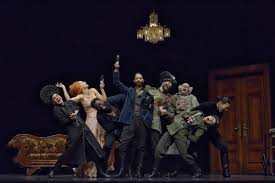
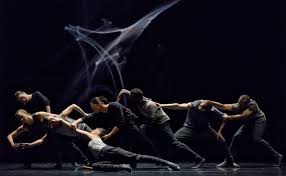
I saw Revisor last night with Holly. It’s the latest dance from choreographer Crystal Pite, with story by Jonathon Young. A Kidd Pivot production.
And it blew me away.
I’ve been a fan of Pite since seeing her award-winning Emergence at the National Ballet of Canada years ago (and I’ve seen it every year since when it’s on offer at NBC). It’s a ballet about insects in a hive and what is means to be part of a community. And it’s beyond fabulous. And … tattoos.
Revisor is an adaptation of Nikolai Gogol’s 1836 play, The Inspector General – a farce, a comedy, about the absolute corruption, oppression, greed, and tyranny within an unidentified “Complex” in the interior of Russia.
Revisor took me a while to get into. The first part of the performance is effectively a retelling or imitation of the play, with recorded dialogue and Russian costumes (and dance, yes). It tells the story of the people who operate the Complex and their purpose – holding prisoners, torturing dissidents, rounding up the masses. And their ultimate purpose is looking out for their own asses when they get word from a “trusted source” that an inspector from the “Centre” is coming to check them out.
After about 20 minutes of watching this story play out, I started to wonder what I had signed up for. A Russian farce about corruption and tyranny wasn’t really what got me out of the house on a Saturday evening (both Holly and I being homebodies on the weekends).
But then Revisor transformed (revised), brilliantly, into a dance performance showcasing the inner machinations of the creator who is adapting the Russian play for a modern audience. The female narrator, representing the creator (both Jonathan as writer and Crystal as choreographer and director, I assume), identifies the key figures in the story and its plot points and translates them into dance movements that drive the heart of the narrative, that reach into the heart of the characters’ motivations.
It reminded me of something very prosaic, but it’s the best analogy I have – the “reveal codes” function in WordPerfect. WordPerfect is a long-gone word processing program people my age used in the olden days; your document is displayed on screen, but with a command, you could “reveal codes” to see the coding behind your document’s formatting. That’s what Revisor did, it revealed the thought process behind transforming a 19th century Russian farce into a 21st century modern dance. It strips away the costumes, the dialogue, and the farce of the first part of the performance and lays bare the creativity and inspiration behind the dance. It stops being an imitation and becomes a very personal, beautiful, and affecting dance performance that, I think, is also an indictment of our modern world.
At one point towards the end of the “reveal codes” piece, the dancer who plays the character of the “subject” (the Revisor mistaken for the Inspector) is left alone on stage. Having learned about the atrocities at the Complex, her (yes, it’s turns out the Revisor is and always was a she, another revision) movements convey her pain. A moment very reminiscent of Heart of Darkness (the horror, the horror, said Kurtz).
The female narrator says repeatedly, as the subject moves about the stage in pain and confusion, the subject is moved. Meaning, the subject is physically moving, the subject is being moved and directed by the creator, the subject is emotionally moved by discovering these atrocities. And the subject is also the creator, moved by the original play and how it resonates in current times. You cannot watch Revisor without believing that it’s inspired by the venal corruption of Trump, his greed, and his debasement of democracy and all things decent.**
And it’s so clever. “Revisor” has so many meanings. First, it’s the Russian character from the original play – the “subject” who shows up at the Complex from the Centre and is mistaken for the titular Inspector. Actually, he’s not an Inspector at all; he’s a revisor – he’s there to change a comma in the Centre’s charter.
And then the creators fundamentally revise the play in the second part to create the “reveal codes” stripped down version of the story.
In the middle of the “reveal codes” piece, the creator also starts pausing – rethinking and editing her own creation – with the narrator chanting that she wants to make one “simple revision”. Again, it’s all about the process of creativity, honing and fine-tuning as one expects a great choreographer like Pite does again and again. The artistic process of determining, in a final piece of art, what stays and what goes.
I haven’t even touched upon the dance, the movements, the fluidity – and sometimes the scary spasmodic jerkiness. I realize I don’t even have a vocabulary to describe it – it’s transfixing. Jermaine Spivey was a wonder as the Postmaster Weiland, a bureaucrat who has seen and read too much and is literally being torn apart with the knowledge of everything that’s going on and not being addressed on the surface.
Last night was the last performance, I’m afraid. If it was on again tonight, I’d be trying to get rush tickets to experience it all over.
**As an endnote, if you really want to get scared about how bad it could get under Trump’s autocratic regime, read Graeme’s blog on how Trump is literally contemplating starting a civil war:
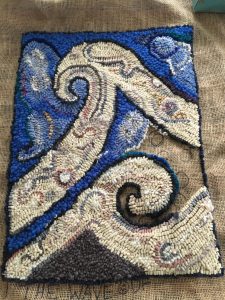
I spent this Saturday afternoon starting to finish my nine (!) rug hooking projects that I’ve completed since last summer. So happy my sister-in-law Anne introduced me to rug hooking and Deanne Fitzpatrick’s studio in Amherst, Nova Scotia. Since then … hours of calm creating these rugs. And a few hours of frustration. The Wave (picture below) was a real challenge for me.
Graeme keeps asking … what are they for? They aren’t for anything. They are for me. What are you going to do with them? Who knows. Anne says some of them can be used as coasters for my coffee.
But the next thing I need to do with them is finish them. They need to be steam-ironed, cut to size, with edges crisply folded. Then the backings get sewn up nice and neat.
Turns out I really like 3/4 of that finishing process – and I got all rugs 3/4 done. But the sewing is not my forte, I’m afraid. I can sew, it’s the “nice and neat” part I struggle with. Looks like I had a seizure when I sewed up Mr. Sheep below. It’s a bit scary, but who looks at the back anyways? Right? I’m hopeful, but not at all convinced, I’ll get better as I work my way through the other 8 rugs.
Pictures below:
Fun compare/contrast – here’s a picture of Anne’s Wave, from the same kit (granted colours do vary). But she really made it her own. I love it. Plus, her stitches are beyond perfect and I’m jealous.
Anne’s rug hooking is at a level I don’t even aspire to. Perfect stitching. She creates her own patterns! Come on.
Graeme says I’m horribly envious, but I like to think that I am unburdened by the strive for perfectionism that afflicts Anne (aka content to be crappy!)